Friday, October 5, 2007

Back in Tbilisi

I’m writing this post in Tbilisi. For those who have been following my blog since its inception, you may have noticed that during the middle of July, the name of my blog changed from “A Summer in Georgia” to “A Summer (?) in Georgia.” No, that wasn’t the result of an HTML script error—it was intentional and the change reflected an idea I began flirting with: what if my experience of Georgia weren’t limited to a summer? What if I took a year off of college to study in Georgia? From my blog posts, you can tell that I was having the best summer ever. I found that I had fallen in love with all aspects of Georgia: its people, food, culture, sights, language, and even the unpredictability of Georgian life.

I should say that this idea was originally not mine. One of my Georgian teachers, Nana, told me during one of my lessons that it would be a shame if I stopped my lessons after only 5 weeks as I was making much progress. And indeed, I too thought it would be a shame to lose what I had worked so hard to gain. With my increasing knowledge of Georgian, I began to speak with Georgians (albeit my conversations were simple) in Georgian. This seemingly simple act enabled me to see Georgia from a Georgian’s perspective. I felt less like a tourist and more like a Georgian.

Nana suggested that I come back in September and study at the medical university and continue taking lessons. And that’s pretty much what I’ve done. I returned to the states on the 28th of August as I originally planned to spend 3 ½ weeks with my family in Rugby. Not once during my summer in Georgia did I feel homesick, yet it wasn’t until I returned to Rugby that I truly realized what I missed most about home; namely, my mother’s cooking, my pets, the isolated world that is Rugby, and of course just being with my family. When the time for me to leave neared, I’ll admit there were moments that I felt like I didn’t want to leave home (But I always feel this way at this time of year when I have to go back to college…).

Before I could go back to Tbilisi, I had to go to Chicago to take care of several tasks. First and foremost was that I had to formally declare to the University of Chicago that I was taking a leave of absence. In addition, I had to retrieve some items I had left in storage (namely winter clothing and textbooks), meet with people interested in my summer activities, and, most important for me, say good-bye to my friends. My 3 days in Chicago seemed so surreal as I watched my friends prepare for the start of the quarter—I could already sense the stress that is characteristic of life at the UofC in my friends as they discussed their classes. I was almost glad that I wouldn’t be a UofC student this year. Don’t get me wrong, I love being a student at the UofC. I take pride in being part of a student body that puts academics before all else—but there’s no getting around the fact that life at the UofC is draining.

After one last all too familiar lunch at Pierce (my cafeteria), I said one last good-bye and headed off to O’Hare. Those familiar with my first hectic journey to Tbilisi will be happy to hear that I had a very enjoyable flight. Other than a 1-hour delay in O’Hare (what can you expect?), my Chicago-Vienna-Tbilisi flights couldn’t have been better (Ok, a direct flight would have been better). My itinerary gave me 12 hours with which to explore the city of Vienna; I used 6 hours of it and would have used more if I hadn’t been wearing only a t-shirt (I wasn’t prepared for the 55 F temperatures). Vienna is a great city to explore if one has only a few hours to do so. I saw most of the major sites (Stephansdom, Hofburg Palace…) as I walked through the old part of the city before I got too cold and took refuge in the Natural History Museum, where I spent more than 2 hours admiring everything from the meteorite collection to the stuffed elephants.

I arrived in Tbilisi the morning (4 am) of the 27th and was greeted as I was back in June by Fr. Theodore and Giorgi Chkheidze. I caught a few hours of sleep in Fr. Theodore’s apartment near the airport before forcing myself to get up and go into the city in my zombie-like state. I met up with Fr. Theodore at Sameba Cathedral (27 September is the feast of the Exaltation of the Most Precious Cross on the Julian calendar) and we headed off to Fr. Theodore’s favorite restaurant. There, I met the Perdues, a farm family from Iowa that I would get to know better. I tagged along as Fr. Theodore ran several errands in preparation for his return to the USA in November before we returned to his apartment.

The next day held a bit more excitement. I was scheduled to meet my candidate host family later that day, but before I even headed out the door, Fr. Theodore received a phone call warning us that there was going to be a large-scale demonstration organized by a newly formed opposition party on the steps of Parliament. Just two days earlier, Irakli Okruashvili, ex-Defense Minister and former ally of President Mikhail Saakashvili, made a dramatic return to politics, introducing his opposition party “Ertiani Sakartvelostvis” (“For a United Georgia”) on broadcast television and at the same time accusing current President Saakashvili of corruption and even having a hand in the accidental death of the former Prime Minister (the official report is that he died of carbon monoxide poisoning). During the evening of the 27th, masked men arrested Okruashvili in his home and he was charged with multiple corruption charges, sparking the call to demonstrate the next day. There probably is some truth to Okruashvili’s accusations, but Okruashvili is also probably no more innocent—such is the state of politics in this post-Soviet Republic. Fortunately, the demonstration, while attracting thousands, was peaceful, but the demonstration marked the first real opposition to Saakashvili and the political situation here is certainly less stable as a result.

Nana, my Georgian teacher, helped me find my host family. Duna and Temo are a married couple in their 50s. Their two-bedroom apartment in the district of Saburtalo was once also the home of their now grown son, Lekso, married and currently working for the Georgian Embassy in Baku (capital of neighboring Azerbaijan). Am I happy living with my host family? Let me just say that Duna is always telling me that I am her “Lekso!” Duna is eager to feed me, and I’m all too eager to oblige. She even fondly scolds me when I leave for classes before letting my hair dry, telling me I will catch my death of cold (a belief she is even surer of since I recently came down with a cold). Temo likes to try to communicate with me in his very limited English (Duna knowing none) which he picked up as a former employee of the Sheraton (he now works for the Ministry of Culture). He’s also a rugby fan (I played rugby briefly before my ankle injury) and is a good friend of the father of the coach of the national team (the Lelos made it to the Rugby World Cup for the second time, only to lose 3 of 4 games)—he’s promised to take me to a match in a couple weeks.

Next post: Vintage and winemaking in Kakheti.

Post to come!

I had a post typed up on my laptop and saved to my flash drive, but the internet cafe I'm in doesn't have available USB ports!! I promise I'll have one if not two posts up sometime tomorrow. In the meantime, check out some recent photos on my flickr site (flickr.com/photos/rugbxym)

Ryan

Tuesday, September 4, 2007

Javakheti Part 2: The summer camp at Mir a Shkhani


The small village (about 50 families) of Mir a Shkhani is an anomaly within Javakheti. First of all, the people there are ethnically Georgian, unusual in the mostly Armenian province. Second of all, they are all Muslim. The village most likely converted during one of the invasions coming from nearby Turkey (only a few kilometers away) several centuries ago.

The camp for college-aged youth (all from Tbilisi) was based in Mir a Shkhani’s two school buildings near the Mtkvari River (the river which eventually flows through Tbilisi). Organized by Metropolitan Nikoloz and funded by World Vision, a Christian organization, the camp was an island of Christianity in this Muslim village. But differences in religious belief never became an issue and the people of Mir a Shkhani welcomed us and showed us the hospitality one comes to expect from Georgians.

Now, this wasn’t your typical summer camp. There was work, hard work. And lots of it. The main objective of the camp was to restore an ancient church carved into the mountainside. It was only discovered 5 years ago—not surprising, as all that is visible from the outside is a small rectangular hole big enough for someone to crawl into—and little is known about its history. It is believed (how, I don’t know) that the church was dedicated to St. John the Baptist and it is for this reason that it is called Tavkvetila—literally, “head severed,” referring to how St. John the Baptist met his end.

There are two rectangular-cut holes that lead into the church. The first, at the base, leads to a vertical shaft 12 feet in height. A ladder provides the only means of gaining entrance to the church. Presumably, the entrance was designed this way in an effort to keep animals out of the church (it worked but not entirely—there was an active swallow’s nest in the church). The second hole is about 30 feet directly above the first. It is the only window into the church and provides all the light. The church is quite large, measuring about 20 ft x 40 ft x 20 ft high, a size that is even more impressive when one considers that it was carved entirely out of rock.

While certainly large enough to hold 40 or 50 worshippers, Tavkvetila is not large enough to contain the crowds that come on September 11th (the feast day of St. John the Baptist on the Julian calendar). In the past, the overflow was forced to stand outside on the uneven terrain (it is a mountainside). But now no longer. The camp participants built two large terraces out of stone on which people can stand outside the church. The larger of the two terraces measures 100 ft long and stands 7+ ft at the highest point. And they did a good job—their progress was regularly evaluated by architects from Tbilisi who praised the students’ excellent work.

Derek and I joined the camp in its second half (in all, 4 weeks). We were rather unceremoniously dropped off by Fr. Theodore who said something about picking us up the next week. Derek and I would be staying in the men’s building (there being 2 parts to the school) in one of the tiny classrooms. The room was tiny, the floors wooden and dusty, and the window had a pane missing. We would be roughing it.

That first afternoon was a bit awkward. Here we were, two Americans who didn’t know much Georgian, arriving halfway through a camp. We exchanged greetings with the 20-odd students at the camp but for the most part, we didn’t speak much with them, instead clinging to Nes and Nino, the two English-speakers. But soon enough, their curiosity of Americans together with their Georgian hospitality and my desire to practice my Georgian broke the ice and very quickly I made many good friends.

As dusk approached that first day, we were visited by 3 monks from Vardzia monastery (the cave monastery). They came bearing gifts of watermelon and fresh honey from their own bee hives. They soon joined a game of volleyball that was underway in the school yard (the volleyball net was a gift from World Vision, and it quickly became a favorite evening pastime, not just for us, but for the entire village). It was quite surreal to watch monks in their cassocks playing volleyball…

Here’s the schedule of a typical day at the camp:
6:00 am: Wake up, brush teeth from spring, drink tea, fill jugs with water from spring under the bridge. Watch the cattle being driven by the villagers into the mountains. The men taking on the large cattle and water buffalo; the women and children driving the calves
7:00-7:30: Depart for worksite 2 km away (Tavkvetila) carrying water jugs, stopping to pick apricots. Ford Mtkvari River and climb up mountainside to reach worksite
7:30-11:30: Perform backbreaking work while we’re still protected by the shade of the mountain. Listen to morning prayers being read by volunteer.
11:30-12:00: Eat delicious lunch prepared by the girls (some of the girls worked at the site, too) back at camp and carried to us by one of the guys who slept in.
12:00-2:00: Return to work; now in the sun
2:00-2:30: Head back to camp; ford river, this time not making an effort to avoid falling in (by now it’s very hot), if haven’t fallen in, pushed in by one of the guys
2:30-6:00: Relax, nap, chat with others, swim in the Mtkvari River
6:00-6:30: Have supper (usually bread, cheese, tomato and cucumber salad, potatoes, pasta, honey)
6:30-8:30 (dusk): play volleyball or soccer with locals
8:30-10:00: talk on the porch, practice Georgian
10:00-10:30: evening prayers
11:00-6:00: sleep, unless interrupted by prank

As we had arrived towards the end of the camp, most of the hard labor had already been completed. The terraces had already been built; all that was left for us to do, was to backfill the larger terrace and excavate two cells below the church (most likely used for storage). The work was still hard, often involving breaking up large rocks; by the end, my hands were quite blistered.

Derek, unfortunately, became quite ill with food poisoning (not at all surprising given that we weren’t living in the most sanitary of conditions; everyone got sick at some point and I would have my turn soon) during our second day at the camp and was subsequently whisked away to the more comfortable monastery in Baraleti to regain strength where he stayed for almost 5 days. Without Derek, I lost the only person I had been speaking in English to regularly. Sure, Nino, Nes, and a few other students could speak English, but they knew that I wanted to learn Georgian so they made a point of speaking to me in Georgian, and they only spoke to me in English when I had no clue as to what they had said. I was totally immersed in Georgian—and I loved it. The English-speakers took it upon themselves to teach me the more difficult aspects of Georgian while the others, mainly the guys, taught me phrases and short poems. The guys especially had a lot of fun with me: they would teach me a phrase that they swore was innocuous and have me repeat it to the girls, which I would naively do. Based on the girls’ reactions, I would find out that the phrase wasn’t so innocuous…

More still to come.

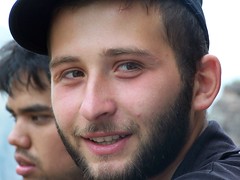
Lasha Dzia


Lasha Dzia
Originally uploaded by rugbyxm
Es aris chemi dzma-katsistvis, Lasha Dzia--Jigari xar!

Sunday, August 26, 2007

Javakheti Part 1: Axalkalaki and the drive to Mir a Shkhani

Many apologies for such a late post about something that happened 3+ weeks ago! I returned from the Black Sea late Wednesday and have been busy getting ready for my trip home (Tuesday morning!) since.

Javakheti is a province of Georgia southwest of Tbilisi. It borders Turkey to the southwest and Armenia to the southeast, and not so coincidentally, it is the home to a significant Armenian population—in fact, they make up the majority of the population. There is much tension between the ethnic Armenians and Georgians in Javakheti and there is even a movement to break away from Georgia. Like Abkhazia, a region of Georgia which successfully broke away in the early 90s (though it is not recognized by any country in the world except Russia), the separatist feelings are supported by Russia. A large Russian military base in the province’s capital Axalkalaki until recently employed ~40,000 Armenians—one can see why the Armenians like the Russians. Now that the base is closing, who knows what will transpire.

Javakheti is also home to some of the most beautiful, untouched terrain in Georgia. It is mountainous, with some peaks above 10,000 feet, in some parts and in others it is steppe. For the most part, Javakheti is treeless, but it was not always so. Several centuries ago, the whole area was heavily forested until one of Georgia’s many invaders set fire to the forest. It burned for seven years and hasn’t grown back since. See my pictures (link in side bar) for a better idea of what Javakheti looks like.

The bishop of Javakheti is Metropolitan Nikoloz, Fr. Theodore’s friend and whom he serves liturgy with, and he is also partly responsible for bringing Derek and me to Georgia. For the past several years now, Metropolitan Nikoloz has organized youth camps in Javakheti. At first they were aimed at university students but have been expanded to include even younger children. Derek and I were to join the university-aged camp which was located in a small village called Mir a Shkhani more than an hour away from Axalkalaki.

We departed from Tbilisi for the Axalkalaki on Tuesday, July 31st, our party consisting of Fr. Theodore, myself, Derek, Loyal (the photographer), and Nino (the film-history student). The drive up was relatively uneventful—we were stopped a couple of times by herds of cattle meandering across the road, an event which Loyal photographed by precariously leaning out the window—and gave me a chance to appreciate the changing scenery. We stopped to eat near Borjomi, a town famous for its healing waters (Stalin, a Georgian and a hypochondriac, made trips there when he could), before continuing on to Axalkalaki.

We arrived after nightfall at Metropolitan Nikoloz’s to find the mid-teens’ camp watching a Finnish film in the bishop’s backyard. Once the film was over, we were briefly introduced before being given a tour of the bishop’s house. It is more a museum than a house, which is exactly what the bishop wants—he has been collecting artifacts, fossils, stuffed animals, paintings, etc… for the past couple of years and has sought advice from museum curators on how to best display his collection. It being late in addition to our being exhausted from the drive up, we didn’t stay long. Derek and I spent the night in a hotel as the Residence (a house next to the cathedral where all the kids were staying) was full.

The next day was the last day for the mid-teens and they left for Tbilisi in the early afternoon. Two of them, Keti and Nestan, stayed behind as they would be joining the university camp with Derek and me and would be traveling with us to the camp. Keti is a 15 year-old girl who has been living in Paris for the past few years and comes home to Georgia as often as she can. Nestan, or “Nes,” has lived in Tbilisi all her life and just graduated from high school. Both girls know a decent amount of English, and Nes, noticing that I was eager to learn more Georgian, was my teacher for the time she was at the camp (only 5 days).

The drive to Mir a Shkhani is a beautiful one rich with history. We first stopped at an ancient castle several centuries old. There, Loyal had a little photo-shoot. Since meeting Loyal and seeing him at work, I have gained a greater interest in photography. As I followed him around in the ruins, I learned some of the basics of photography. I also saw the lengths to which a photographer will go to get a perfect shot, which in this case meant Loyal lying on his back in cow dung to photograph the opening in the tower above.

Next stop was a stop to drink spring water near Vardzia, the ancient cave-city founded in the 12th century by Queen Tamar. At its height, over 700 people (mostly monks) lived in this city which had over 6,000 rooms. In the 13th century, a large earthquake sheered more than 2/3 of the city away from the mountain side. Today, we can see the rooms exposed by the earthquake, but before the earthquake, one would have had to look hard to see any sign of a cave complex.

Just a few miles away is the village of Mir a Shkhani where we headed next… more about my time there in part 2.

Tuesday, August 14, 2007

Off to the Black Sea

I apologize for not posting about my time in Javakheti. Now, I'm off to the coastal town of Kobuleti with some of my friends from the trip to Javakheti. Keep your fingers crossed for easy internet access there...

Sunday, August 12, 2007

I'm Back


I've just returned from Javakheti and am exhausted (had to get up at 5), so I won't give a lengthy post just yet. But I'll tell you that my time there was the best part of my trip so far.