As I mentioned in a previous post, my chemistry professor, Mzia, invited me to come work in her laboratory at the Institute for Physical and Organic Chemistry. She had warned me that conditions there were bad: there wasn't always running water, electricity wasn't guaranteed either, heating couldn't be afforded, etc... But I wasn't put off in the least; after all, I'm living in those conditions in my apartment.
Yet when I approached the building for the first time last Friday, I realized that Mzia had made the facilities sound relatively good compared to what I was looking at. The exterior of this soviet-era building is falling apart, and it's even worse on the inside. I entered through a side door and descended a flight of stairs to a poorly lit basement that had large gaping holes in the floor where I rode a rickety elevator to the third floor. I might as well have been in a horror movie. Again, the lighting was poor, but slightly better due to the sunlight streaming through the windows. Mzia gave me a brief tour of her lab (Organic Synthesis) and the lab of her colleague, Roini (considered to be one of the best chemists in Georgia, who, in spite of the conditions, consistently gets better results than his colleagues in Moscow). Besides the overall poor condition of the fume hoods and lab equipment that one would expect from a laboratory that hadn't been upgraded since the soviet-era, I was struck by the dozens of two liter plastic beer and soda bottles. These vessels held precious water. I don't think it needs mentioning, but water is necessary for chemistry. At the institute, water only runs for 3 hours, 3 days a week--that's only 9 hours a week of water! The powers that be at the institute restrict the water supply citing costs; for the same reason, they also forbid heating the building (which is why no one takes off their coat in the lab). Last year, there weren't enough funds even for electricity, so for 5 months, research came to a halt, except in Roini's lab: he used a propane stove to perform most of his experiments and somehow managed to still get good results. As Mzia told me, If you can synthesize in Georgia, you can synthesize anywhere.
Mzia then invited me for some coffee and a chance to review some of her research (currently, synthesizing compounds with anticoagulant and antioxidant properties). I also read one of the lab's research papers still in the drafting stage. I noticed many grammatical mistakes which Mzia kindly allowed me to correct; this is probably how I can help the institute the most. That and perhaps grant writing. She also reminded me that my work would be without pay as the institute did not have funds for another salaried position. She revealed that her monthly salary, as the director of a lab mind you, is $100 (one hundred, in case you thought I left out a zero) and she comes to the institute almost everyday. Shortly, Roini arrived with a liter of Odessa wine, and within a matter of minutes, it was gone--I've almost come to expect now that I'll be drinking in the oddest of places. After what I thought was the last toast, Nino, one of Roini's research assistants, came in to announce that the water had stopped running, and also came bearing another 1.5 liters of wine, which didn't last long either. In spite of downing a liter of wine, I was still conscious enough to say that I would be back the next day to start helping out.
I did come the next day to Roini's lab, where Roini and Nino had already been working for a few hours. Roini wasn't in best form because apparently, the day before, after drinking with me, he went to a friend's birthday party where he drank 5 (!) more liters of wine and was paying for it now with a hangover. Therefore, Nino and I (to some extent) took over the experiment, which mainly involved pouring water from a plastic bottle into a funnel to feed water to the condenser. Nino knows very good English and has been kind and patient enough to explain the experiment in detail (we're synthesizing a ruthenocene derivative). When things slowed down, Nino prepared a lunch of fried potatoes, cheese, and various pickled vegetables for the three of us (yes, there is a small kitchen in the laboratory). And of course, Roini brought out another liter of wine. I think I'm going to like working here...
Tuesday, November 6, 2007

Ministry of Education/Bureaucracy
Although I have been attending classes at TSMU for almost 6 weeks now, I am still not officially enrolled. When I submitted my application materials to the University in mid-August, the head of Admissions informed me that all applicants must be approved by the Ministry of Education in order to be admitted. I wasn't worried at the time because I knew I was a well-qualified applicant (having already completed two years of college--most of the applicants just graduated from secondary school) and had gone through all the bureaucratic mess (or so I thought) of among other things, getting an official transcript sent to Georgia, translated, and notarized.
But when I returned to Georgia at the end of September, I discovered that my application still hadn't been approved. I was told that my application couldn't be approved until my transcript was verified. What?! The whole point of having an official transcript (one that was translated and notarized to boot) is to avoid having to verify its authenticity. I didn't take much action, thinking that this bureaucratic mess would just untangle itself; after all, many of my classmates were in the same situation and they had to be admitted sooner or later, right? Moreover, for me, being a student at TSMU is just a small part of my whole Georgia experience--no big deal if it doesn't work out for some reason. But for my classmates, this was a big deal. They had come from as far as India with the sole intent of studying medicine--not to experience Georgian culture or to learn Georgian--and yet the University, now six weeks into the semester, still has not given the word on their admission. We are in a bureaucratic limbo.
That's why last Wednesday a fellow classmate and I decided to go in person to the Ministry of Education and get some real answers. I went armed with phone and fax numbers of the Office of the Registrar at the UofC (having also sent them emails describing my situation) and another official copy of my transcript. But I hardly needed anything. A woman named Maia apparently held all the decision making power, and when I showed her my official transcript (which they already had) that I had brought, she said that I should have no problem being approved. The same went for my classmate. I almost wish there would have been more of a struggle because then I could feel as though I had accomplished something; instead, I left with an even greater distaste for bureaucracy and its inefficiency.
But when I returned to Georgia at the end of September, I discovered that my application still hadn't been approved. I was told that my application couldn't be approved until my transcript was verified. What?! The whole point of having an official transcript (one that was translated and notarized to boot) is to avoid having to verify its authenticity. I didn't take much action, thinking that this bureaucratic mess would just untangle itself; after all, many of my classmates were in the same situation and they had to be admitted sooner or later, right? Moreover, for me, being a student at TSMU is just a small part of my whole Georgia experience--no big deal if it doesn't work out for some reason. But for my classmates, this was a big deal. They had come from as far as India with the sole intent of studying medicine--not to experience Georgian culture or to learn Georgian--and yet the University, now six weeks into the semester, still has not given the word on their admission. We are in a bureaucratic limbo.
That's why last Wednesday a fellow classmate and I decided to go in person to the Ministry of Education and get some real answers. I went armed with phone and fax numbers of the Office of the Registrar at the UofC (having also sent them emails describing my situation) and another official copy of my transcript. But I hardly needed anything. A woman named Maia apparently held all the decision making power, and when I showed her my official transcript (which they already had) that I had brought, she said that I should have no problem being approved. The same went for my classmate. I almost wish there would have been more of a struggle because then I could feel as though I had accomplished something; instead, I left with an even greater distaste for bureaucracy and its inefficiency.
Friday, November 2, 2007
What you have to look forward to:
This weekend has been and will be a busier one than usual; and as a result, I don't have the time I usually do to write my weekly post in its full 1200+ word glory. I hope to find time by Tuesday to write it. Here's what you can expect:
- Visit to the Ministry of Education
- Visit to the Institute of Physical and Organic Chemistry, where I will be working, and my, let's just say, very warm welcome.
- The 100,000+ demonstrators in front of Parliament on Friday
- Trip to Sighnaghi on Sunday for Giorgi'a birthday party
- And probably more
Wednesday, October 31, 2007
დამეხმარე!
Word of the Day: დამეხმარე (damexmare)
Definition: Help me!
Any one who has visited Tbilisi and walked down any of the popular streets or through a pedestrian underpass has certainly heard this word. It is the plea uttered by the countless beggars of Tbilisi.
The beggars can be classified into 3 categories: 1) Widows and the Disabled 2) Unemployed Georgians 3) Gypsies
The widow beggars are easily identified by their worn faces, black dress, and black headscarves. Most of the widows are too feeble to actively walk the street begging (and obviously, neither are the disabled); instead, they sit on the steps leading down to the pedestrian underpasses or on street corners. Most don't even utter a word, only holding out an outstretched hand or a container with an icon taped to it. Most of these widows either have no children to take care of them or children who are too poor themselves. A similar story goes for the disabled. Georgia does have a pension program, but it is a joke. All pensioners are guaranteed a monthly allowance of 25 laris (roughly $15), only enough to buy a loaf of bread each day. And even this petty amount is a huge increase from Shevardnadze's time only 4 years ago--it was 7 laris per month then. Of all the beggars, these widows deserve help the most.
Georgia has a high unemployment rate. Official reports put the figure at 12.6%, but most agree that it is actually higher. What is unusual about Georgia's unemployed is that just as many of them are educated as uneducated--perhaps even more with such a large demand for construction workers in the current housing boom. For an unemployed men, there seems to be several stages before they hit beggarliness. First, he tries to find construction work as a day laborer. You can tell if a man by the side of the street is day laborer if he has a drill displayed in front of him. If that doesn't work out, then he might collect glass bottles, or if he's musically inclined, play in the Metro station. If all else fails, he will beg. Most are too ashamed and hide their faces; their hands outstretched, sitting next to the widows.
Gypsies (ბოშები) is a misnomer because the Gypsies of Tbilisi are not related in any way to the Gypsies (Roma) of Europe. Like their Roma cousins, these Gypsies have their own culture and speak their own language. The Gypsies of Tbilisi thrive off of others through begging and occasionally theft. Most of the Gypsies one encounters in Tbilisi are either children or young mothers, both of whom attract a great deal of sympathy--which is exactly what the Gypsy clan wants. As desperate as these children may appear, it would be a mistake to give money to them because it is a well known fact that the money these children receives goes not to themselves, but to rich Gypsy men. For this very reason, The Cathlicos-Patriarch of Georgia, Ilia II, himself has instructed Georgians not to give money to the Gypsy children. But the Gypsies are very persistent beggars and smart beggars, and will chase people they suspect are the most sympathetic (foreigners automatically fall into this category) or annoy someone until he pays. Some of them even resort to scare tactics, such as threatening to touch someone with their spit-covered hands or to put a curse on them if they don't pay.
Definition: Help me!
Any one who has visited Tbilisi and walked down any of the popular streets or through a pedestrian underpass has certainly heard this word. It is the plea uttered by the countless beggars of Tbilisi.
The beggars can be classified into 3 categories: 1) Widows and the Disabled 2) Unemployed Georgians 3) Gypsies
The widow beggars are easily identified by their worn faces, black dress, and black headscarves. Most of the widows are too feeble to actively walk the street begging (and obviously, neither are the disabled); instead, they sit on the steps leading down to the pedestrian underpasses or on street corners. Most don't even utter a word, only holding out an outstretched hand or a container with an icon taped to it. Most of these widows either have no children to take care of them or children who are too poor themselves. A similar story goes for the disabled. Georgia does have a pension program, but it is a joke. All pensioners are guaranteed a monthly allowance of 25 laris (roughly $15), only enough to buy a loaf of bread each day. And even this petty amount is a huge increase from Shevardnadze's time only 4 years ago--it was 7 laris per month then. Of all the beggars, these widows deserve help the most.
Georgia has a high unemployment rate. Official reports put the figure at 12.6%, but most agree that it is actually higher. What is unusual about Georgia's unemployed is that just as many of them are educated as uneducated--perhaps even more with such a large demand for construction workers in the current housing boom. For an unemployed men, there seems to be several stages before they hit beggarliness. First, he tries to find construction work as a day laborer. You can tell if a man by the side of the street is day laborer if he has a drill displayed in front of him. If that doesn't work out, then he might collect glass bottles, or if he's musically inclined, play in the Metro station. If all else fails, he will beg. Most are too ashamed and hide their faces; their hands outstretched, sitting next to the widows.
Gypsies (ბოშები) is a misnomer because the Gypsies of Tbilisi are not related in any way to the Gypsies (Roma) of Europe. Like their Roma cousins, these Gypsies have their own culture and speak their own language. The Gypsies of Tbilisi thrive off of others through begging and occasionally theft. Most of the Gypsies one encounters in Tbilisi are either children or young mothers, both of whom attract a great deal of sympathy--which is exactly what the Gypsy clan wants. As desperate as these children may appear, it would be a mistake to give money to them because it is a well known fact that the money these children receives goes not to themselves, but to rich Gypsy men. For this very reason, The Cathlicos-Patriarch of Georgia, Ilia II, himself has instructed Georgians not to give money to the Gypsy children. But the Gypsies are very persistent beggars and smart beggars, and will chase people they suspect are the most sympathetic (foreigners automatically fall into this category) or annoy someone until he pays. Some of them even resort to scare tactics, such as threatening to touch someone with their spit-covered hands or to put a curse on them if they don't pay.
Sunday, October 28, 2007
Georgian Word of the Day
I thought I would add a bit of variety to my blog and start a series of smaller posts each dedicated to a particular Georgian word that I feel is worth writing about.
Today's word: magari (by the way, Georgian makes no distinction between upper and lower cases)
Magari is an adjective literally meaning "hard, firm, or solid," but I've almost never heard it used this way. The first time I remember hearing this word was when I visited the Gergeti Trinity Church in Kazbegi last July. I'm sure I had heard the word before then, but it was used that day by so many of the pilgrims when they finished the climb and beheld the church in it's foggy glory for the first time. Over and over again I heard "magaria, magaria" (The "a" added to the end of adjectives and nouns is an abbreviation for the verb "aris," "it is."). At that point in my language studies, I wasn't even aware of the dictionary definition of "magari," but even if I had been, I wouldn't have known what to make of it (Yes, the church is solid??).
Later that day at a restaurant, I heard "magari" used to describe food. "Es magari puria" (this is _____ bread) and "magari khinkali" -- I knew that neither was "firm or solid;" at that point, I asked my teacher, Nana, what "magari," or as an exclamation, "magaria," meant. The answer: it's an exclamation of surprise and satisfaction--similar to our "amazing."
Since that day, it seems like I hear "magari" in every other sentence. Indeed, it's the current "in" word. But that's not to say that "magari" can't be used for it's literal meaning. Just today, I told my homestay "mom" that the cheese she served me was "magaria." "No," she quickly corrected me (in Georgian, of course), "it's not firm at all--it's a soft gouda."
Today's word: magari (by the way, Georgian makes no distinction between upper and lower cases)
Magari is an adjective literally meaning "hard, firm, or solid," but I've almost never heard it used this way. The first time I remember hearing this word was when I visited the Gergeti Trinity Church in Kazbegi last July. I'm sure I had heard the word before then, but it was used that day by so many of the pilgrims when they finished the climb and beheld the church in it's foggy glory for the first time. Over and over again I heard "magaria, magaria" (The "a" added to the end of adjectives and nouns is an abbreviation for the verb "aris," "it is."). At that point in my language studies, I wasn't even aware of the dictionary definition of "magari," but even if I had been, I wouldn't have known what to make of it (Yes, the church is solid??).
Later that day at a restaurant, I heard "magari" used to describe food. "Es magari puria" (this is _____ bread) and "magari khinkali" -- I knew that neither was "firm or solid;" at that point, I asked my teacher, Nana, what "magari," or as an exclamation, "magaria," meant. The answer: it's an exclamation of surprise and satisfaction--similar to our "amazing."
Since that day, it seems like I hear "magari" in every other sentence. Indeed, it's the current "in" word. But that's not to say that "magari" can't be used for it's literal meaning. Just today, I told my homestay "mom" that the cheese she served me was "magaria." "No," she quickly corrected me (in Georgian, of course), "it's not firm at all--it's a soft gouda."
Friday, October 26, 2007
Week in Review
Sunday:
Went to Tbilisoba, the annual festival celebrating the city. Unfortunately, there were many thousands of people and not much to do (unless looking at carved fruits is your thing). There was no shortage, however, of churchkhela, the snack made of hazelnuts or walnuts dipped in grape syrup (it tastes about as you would imagine it, though not very sweet--you can see me biting down on one at my flickr site), as vendors sold every imaginable variety throughout the fairgrounds. By the time evening arrived, Rustaveli, the main street in Tbilisi, was shut down as thousands gathered to watch a concert given by the Italian group Ricce e Poveri (I've never heard of them before). I made the smart decision of getting back home and watching the concert on TV before the city's public transportation system became overwhelmed.
Monday:
My first class on Monday is Biology practical. The goal of our practical lessons is to discuss in more detail what was covered in lecture. My lecture is given by one professor and my practical session is led by another. Prof. Dato, my practical professor, is a nice guy who is quite enthusiastic about biology, but he doesn't know a thing about teaching. Again, the lack of textbooks makes teaching difficult in the first place, but even so, Prof. Dato never has a lesson plan for us and instead discusses what he wants to discuss. For me, this makes class more interesting, as I've already studied the material, but for my classmates, it's an utter disaster. He's obsessed with his out-of-date biology computer programs, and inevitably we gather around his equally out-of-date computer (it runs on Windows 98!) to watch animations about the construction of the cell-membrane. Then there are pointless tasks, such as last week, when he had me memorize in class a list of organisms and their corresponding genome sizes.
This leads me to a general statement about the quality of education at TSMU: It's not very good. I do find Anatomy(the practical portion of it, anyway) and physics to be well taught, as are the language classes. As for chemistry, our professor is quite bright and and a good teacher, but she is faced with the impossible task of teaching all of general inorganic chemistry in one semester. In Biology, as I've already described, the professors lack basic teaching skills. In History of Medicine... well, just read my previous post. But, as our physics professor confided in us, the English-language program (i.e. for international students) is far much better than the Georgian-language program. It's impossible to teach the Georgians, he says, because there is chaos in the classroom and a general lack of effort; a consequence of letting 16 and 17 year olds study medicine. Not surprisingly, very few Georgians from TSMU make it into residency programs in the US, and those that do, do so by working on their own.
Tuesday:
When I walked into Anatomy lecture, I was surprised to see that the number of Indian students had doubled. Apparently, 20+ Indians just arrived a few days earlier, having been delayed by visa issues. I also met one new student from Pakistan. With so many more students, lectures have only become louder and more likely to be interrupted by a Bhangra ring tone. Perhaps due to ethnic exclusivity or more simply because I am in a "Turkish group", I haven't had a chance to get to know well any of my Indian classmates; by contrast, I have several good Turkish friends.
Georgian lessons with Nana:
Four times a week I'm reminded how insane a language Georgian is. Here's an example: In the present and future tenses, the verb "to do or make" (akateb) takes a nominative subject, but in the past tense, the subject is in the ergative case, not the nominative. Here's another: the verb "to eat" (chame) takes a dative object in the present and future, but in the past tense, the object (i.e. what's being eaten) is in the nominative case!! And in the pronunciation department, having to distinguish between 3 k's, 3 ch's, 2 t's, 2 ts's, 2 p's, and 2 r's... In spite of all of the challenges that Georgian presents, I'm actually doing quite well and if things continue as they are, I'll finish the program I've been learning from by the end of the year (meaning I'll have learned all of Georgian grammar).
Wednesday:
Had another plagiarism-filled History of Medicine class, only after the professor showed up 45 minutes late. Also had my first Russian class of the semester (TSMU requires all international students to study 3 languages: Georgian, Latin, and either Russian, German, or French) which looks to be promising. The teacher knows hardly any English (to give you an idea, my Georgian is better than her English) so we are immersed in Russian. Luckily for me, I studied some Russian back at Chicago, so I wasn't totally lost and was able to help out my Turkish group-mates.
Thursday:
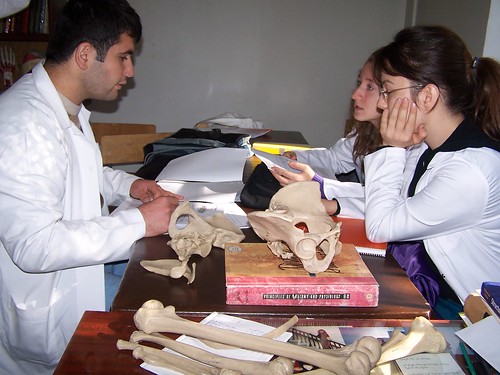
Had another worthwhile Anatomy practical session. Manana, my teacher, insists that I know the vertebral column better than she does so whenever there is a student who has just joined the group (at least 3 or 4 have done so) and doesn't know what we covered from week one (the vertebral column), she assigns me the task of explaining the entire vertebral column to the unfortunate student. After having to explain it so many times, I almost do feel like an expert on the vertebral column...
All of our practical classes consist of two 45-minute halves with a ten minute break between. For most students, break means a chance to smoke. Well more than 50% of students smoke, a habit that is much more affordable in Georgia considering that a pack of cigarettes can cost as little as a dollar. During break, I leave the classroom with my classmates to stand outside and watch them smoke (I have no intention to start smoking!).
During Chemistry practical on Thursday, our chemistry professor, Mzia, joined me and my friends during our "smoke break." After some introductions, which included the discovery by Mzia that I was from America--a moment that always makes the professor say "Really!!"--and a brief conversation among the smokers about what the world's come to if you can't smoke inside public buildings (you can in Georgia, though), I discovered that Mzia is the director of organic synthesis at some laboratory (forgot the name). When I told her that I loved organic synthesis (yes, I know, I'm weird), she said that there would be no problem if I wanted to volunteer (they don't have much funds) in her lab. She said that working in the lab is always an interesting experience because there isn't always water and electricity, and in the winter, there is virtually no heating.
Friday, October 19, 2007
The History of Medicine
Tbilisi State Medical University requires all first year students to take History of Medicine. In principle, it is a good idea, but… As I mentioned in my previous post on TSMU, textbooks are non-existent, which makes teaching history rather difficult. The professor’s solution is quite simple, but extremely boring: read out loud from his tattered photo-copied book. A word about the professor: He looks to be about in his late 50s or early 60s, always dresses well, and speaks in a thick accent. Virtually all of my classmates agree that the class is a complete waste of time, not because they don’t value the subject, but because they cannot understand a word he says half the time. He demands absolute silence when he is “lecturing,” yet when his cell phone rings in class, he doesn’t hesitate to interrupt class to take his call (a habit not unique to this professor, unfortunately). Not one to waste time, I’ve managed to block out the drone of the professor’s voice whilst I do my Georgian homework.
Either to make class more interesting or perhaps just to give his voice a break, or both, the professor announced at our first class that each student will be required to write a 5 page report and give a 10-15 minute presentation on a topic relating to the history of medicine. Many of the Indian students were assigned topics relating to traditional Indian medicine; the Turkish students, Turkish medicine; the few Georgian students, Georgian medicine; and as for myself: pre-Colonial American Medicine.
Knowing that many of my classmates have difficulty comprehending English, I wondered how they would manage to write a research paper. They managed perfectly fine, as I discovered at the first day of presentations—with the aid of the internet, that is. I asked Ahmet, the first student to give a presentation, how much time it took him to write his paper. “It was very easy,” he said “all I did was find the information on the internet and copy it into Word.” I was too naïve to consider the possibility that most students would resort to plagiarism to accomplish what for them is this nearly impossible task. At least Ahmet knew English well enough and had practiced his presentation enough times that he delivered his plagiarized research as though it were his own; the “Cuba girl” didn’t fare as well.
The second presentation was on the topic of medicine in Cuba. Unfortunately, the “researcher,” a Turkish girl wearing a red bandana on her head and a t-shirt depicting a caricature of Castro, copied the wrong source from the internet: an obviously biased source, probably from the Cuban government itself. For 15 minutes, we sat through a passionate (in words, not delivery) testimony to the superior quality and low cost of Cuban medicine. As if that weren’t enough to convince a listener of plagiarism, every once in a while there would be a sentence that went like this: “Because of the low cost and equal if not superior quality of medical education in Cuba, we now even have low-income students from the US studying in Cuba…” When she had finished, the professor asked her out-right if the work was hers, and after having the question translated by one of her Turkish friends, she said “of course,” handing her hand-written/copied report to the professor as evidence.
At the conclusion of the “Cuba girl’s” presentation and with five minutes left in the class, the professor polled the class on where we were from. Responses of “India” and “Turkey” filled the room, and then one student said “There is one American.” As if on cue, heads began to turn in search of this American. Frankly, I had assumed that word had spread and that everyone knew by now that there was an American in their midst. I confessed that I was indeed the American, which immediately led to a lot of introductions from classmates.
One of my new acquaintances took things a step further by inviting me to a Turkish restaurant. I half-heartedly agreed, because on the one hand I didn’t want to miss an opportunity to make another friend, but on the other, I feared that I was being singled out solely for my being American. After my last class of the day, Latin (another bore), I met Necip at the gates of the University as we had agreed. We greeted one another Turkish style: by touching first our left cheeks and then right cheeks together (Georgians, by contrast, greet each other with a kiss on the cheek). Necip first apologized for his poor English, but he actually speaks quite well, especially when one considers that he has only studied the language for two years. Next, Necip told me how humble I was, saying that most of the Americans he’s made contact with think very highly of themselves. I didn’t know quite how to take this compliment, but I did feel surer that Necip’s offer of friendship was genuine.
At the restaurant, Necip was a great host, ordering a delicious meal of lentil soup, Turkish-style shwarma, baklava, and Turkish tea. During the course of our meal, we kept our conversation simple, discussing our families and studies at the university, Necip making use of his mini-dictionary and phrasebook when he grasped for words. Necip is from Bursa, a Turkish city south of Istanbul. I discovered that Necip’s father, a coal miner, is Kurdish. Necip is also a dedicated student, telling me that he puts studying before all else (and it pays off for him: he got the highest score on our chemistry quiz). We left the restaurant our separate ways, but not before promising another outing in the near future. It’s meeting people like Necip that makes being a student at TSMU all the worth while.
Either to make class more interesting or perhaps just to give his voice a break, or both, the professor announced at our first class that each student will be required to write a 5 page report and give a 10-15 minute presentation on a topic relating to the history of medicine. Many of the Indian students were assigned topics relating to traditional Indian medicine; the Turkish students, Turkish medicine; the few Georgian students, Georgian medicine; and as for myself: pre-Colonial American Medicine.
Knowing that many of my classmates have difficulty comprehending English, I wondered how they would manage to write a research paper. They managed perfectly fine, as I discovered at the first day of presentations—with the aid of the internet, that is. I asked Ahmet, the first student to give a presentation, how much time it took him to write his paper. “It was very easy,” he said “all I did was find the information on the internet and copy it into Word.” I was too naïve to consider the possibility that most students would resort to plagiarism to accomplish what for them is this nearly impossible task. At least Ahmet knew English well enough and had practiced his presentation enough times that he delivered his plagiarized research as though it were his own; the “Cuba girl” didn’t fare as well.
The second presentation was on the topic of medicine in Cuba. Unfortunately, the “researcher,” a Turkish girl wearing a red bandana on her head and a t-shirt depicting a caricature of Castro, copied the wrong source from the internet: an obviously biased source, probably from the Cuban government itself. For 15 minutes, we sat through a passionate (in words, not delivery) testimony to the superior quality and low cost of Cuban medicine. As if that weren’t enough to convince a listener of plagiarism, every once in a while there would be a sentence that went like this: “Because of the low cost and equal if not superior quality of medical education in Cuba, we now even have low-income students from the US studying in Cuba…” When she had finished, the professor asked her out-right if the work was hers, and after having the question translated by one of her Turkish friends, she said “of course,” handing her hand-written/copied report to the professor as evidence.
At the conclusion of the “Cuba girl’s” presentation and with five minutes left in the class, the professor polled the class on where we were from. Responses of “India” and “Turkey” filled the room, and then one student said “There is one American.” As if on cue, heads began to turn in search of this American. Frankly, I had assumed that word had spread and that everyone knew by now that there was an American in their midst. I confessed that I was indeed the American, which immediately led to a lot of introductions from classmates.
One of my new acquaintances took things a step further by inviting me to a Turkish restaurant. I half-heartedly agreed, because on the one hand I didn’t want to miss an opportunity to make another friend, but on the other, I feared that I was being singled out solely for my being American. After my last class of the day, Latin (another bore), I met Necip at the gates of the University as we had agreed. We greeted one another Turkish style: by touching first our left cheeks and then right cheeks together (Georgians, by contrast, greet each other with a kiss on the cheek). Necip first apologized for his poor English, but he actually speaks quite well, especially when one considers that he has only studied the language for two years. Next, Necip told me how humble I was, saying that most of the Americans he’s made contact with think very highly of themselves. I didn’t know quite how to take this compliment, but I did feel surer that Necip’s offer of friendship was genuine.
At the restaurant, Necip was a great host, ordering a delicious meal of lentil soup, Turkish-style shwarma, baklava, and Turkish tea. During the course of our meal, we kept our conversation simple, discussing our families and studies at the university, Necip making use of his mini-dictionary and phrasebook when he grasped for words. Necip is from Bursa, a Turkish city south of Istanbul. I discovered that Necip’s father, a coal miner, is Kurdish. Necip is also a dedicated student, telling me that he puts studying before all else (and it pays off for him: he got the highest score on our chemistry quiz). We left the restaurant our separate ways, but not before promising another outing in the near future. It’s meeting people like Necip that makes being a student at TSMU all the worth while.
Subscribe to:
Posts (Atom)

