Last weekend I made the trip to Kakheti once again. This time, I was invited by my Georgian teacher, Nana, to join her band of friends and visit Bodbe Monastery and the town of Sighnaghi. This past summer, I participated in two of Nana’s trips: one to the mountains and Gergeti Trinity Church, the other to Bodbe Monastery, where we were going again. As I had been to Bodbe twice before and had seen all there is to see, I was a bit reluctant to go, but Nana convinced me by telling me that there would be Georgians my age coming, too. Not one to turn down opportunities to meet new people, I signed up.
Of the five young people that Nana had promised, I got to know Nick and Lika, two 19-year old university students, the best. They also happened to speak the most English, a fact that constantly bothers me and compels me to study Georgian more. Nick and Lika are successful ski instructors in Gudauri and recently, they have created their own travel agency targeted primarily at Georgian students who wish to see more of their own country. One travel package they gave as an example seemed too good to be true: 10 days in Gudauri with food, lodging, skis, and instruction—all for 350 GEL, or approximately $215.
If you’re interested in Bodbe Monastery, please read my previous posts. We didn’t see as much there this time because there were huge crowds of people as part of the Svetitskhovloba (day honoring the “life-giving pillar” in Mtskheta) celebrations. Next, we visited Sighnaghi. The last time I had been in Sighnaghi, the city was a mess as hundreds of workers were working around the clock to complete a government-funded renovation of the city in time for the ribbon-cutting this month. The aim was to make the town look as it did in the 18th or 19th centuries in order to attract tourists, and seeing Sighnaghi today, they’ve done a pretty good job. Already, western tourists can be seen walking the streets with their cameras hanging from their necks. Go to my flickr site to see the new Sighnaghi and if you dig deep enough, you’ll find pictures of dusty Sighnaghi from this summer.
We did manage to visit a part of Kakheti I had never seen before. One of our party knew that there were two monasteries somewhere up in the mountains, so we set off to find it. Just outside the monastery, we met one of the monks and he was kind enough to give us a personal tour of the grounds. First we visited the convent, on the grounds of which stood a church dating back to the 9th century. A few hundred meters up the mountain from the convent was the men’s monastery. The 12th century church there still had frescoes dating from its construction. Both the convent and the monastery were set against the beautiful backdrop of the changing foliage. [Pictures soon to be on flickr site]
Friday, October 19, 2007

Friday, October 12, 2007
Studying at TSMU
Tbilisi State Medical University’s main campus is located on Vaja-Pshavela Avenue in the Saburtalo district of Tbilisi, a couple miles west of downtown. The campus itself is quite small, consisting of only 3 large white buildings which, together with the street, enclose the “grounds” (nothing more than a few trees and benches). The university is divided into several departments of instruction: the faculties of medicine (by far the largest), dentistry, public health, and various graduate programs in the sciences. All in all, the university enrolls approximately 5,000 students.
TSMU is considered to be a prestigious medical university within Georgia, and during the Soviet era, was considered to be only second to Moscow. Georgian students who wish to enroll at TSMU must perform spectacularly on the National Exams. For international students such as myself, however, the only requirement is $2,000 and a transcript—and approval by the Minister of Education, a feat which I’ve found to be terribly frustrating as I and many of my classmates still haven’t been “approved.”
Medical education in Georgia is a six-year process as opposed to our four. In Georgia, students go straight to medical school after graduating from high school—there is no college intermediate. So in reality, the first two years at TSMU closely resemble a pre-med program (i.e., theory classes such as chemistry, physics, biology, etc…) at a US college. Since I’m halfway through my own pre-med college education, I am already quite familiar with most of the material being taught. But that’s ok, because I’m here to learn Georgian and experience Georgia—not to get my medical education from Georgia. Why, then, am I a student at TSMU? For three reasons: 1) it’s a cheap way to learn Georgian (the $2,000 includes Georgian language classes) 2) as I am a pre-med student who has taken a leave of absence from the University of Chicago, I won’t be rusty when I return and 3) this is a unique opportunity to be an international student and meet other students from around the world in a setting where I’m also an outsider.
For those who might be wondering how I and the rest of the international student population manage to study medicine in Georgian, a language one wouldn’t learn unless in Georgia, the instruction for international students (and a handful of Georgian students with aspirations to leave Georgia for further medical studies or residency) is in English. Because of this, we international students are effectively isolated from the Georgian students. And within our own little world, we are further isolated into groups: each group, usually consisting of 10 students, takes all the same classes together. Only during lectures do all groups mingle. In a way, it is nice to be in groups because I know that our group will become very close-knit.
Overwhelmingly, my first-year classmates (totaling around 40 students) come from one of two countries: either India or Turkey. It makes sense that there would be a sizeable portion of students coming from neighboring Turkey, but as for the Indians, the only rationale I have for their coming in such large numbers is that Georgia is the closest “European” (technically, it’s in Asia) country to India. There is one Thai, and technically speaking, a German and another American, but they don’t count—they were both born in Georgia and speak fluent Georgian. I’m the only first-year student born west of Turkey.
I did get a chance to meet three upperclassmen from Trinidad and Tobago, but as far as I know, I’m the only true American at the university, a fact that’s always begs the question: “So, why in the world would you ever come to TSMU?” Before they jump to the conclusion that I must be some failure who couldn’t get accepted at an American institution, I explain that I’m here for Georgia, not for medicine. Which of course leads to the next question: “Why would you ever want to come to Georgia in the first place? And why of all things would you want to learn Georgian!?” I try my best to explain that I like Georgia for its people and culture, but more often than not I still see “he’s crazy” in their eyes.
In return, I like to ask my colleagues the very same question of why they are at TSMU. The majority of responses go like this: “I didn’t do well enough on the national exams back in Turkey/India to study at a Turkish/Indian school, but if I study well for two or three years here in Tbilisi, I can go back home and complete my education there.” As one of my Turkish group-mates put it to me during a particularly boring Physics class, “Four questions. If I hadn’t missed four questions [on the national exam], I would be in Turkey right now.” The same story goes for Sopho, the Georgian-German student; as for Nick, the Georgian-American who graduated from an American high school, he hopes to get ahead of the game by graduating from medical school and entering a US residency program two years before his American counterparts. No one, it seems, intends to stay at TSMU for the full six years; even Nick plans to transfer to a private institution in Tbilisi (Aieti) which has a better track record of putting its students into US residency programs.
There are eight other students in my group: six Turks (Merve, Irmak, Serhat, Ertan, Muhammet, and Saliha—these are approximations of spellings at best!), Sopho, the pseudo-German, and one Indian student whose name I have yet to learn. My group is relatively diverse: the other groups tend to be made up of entirely one ethnic group (i.e. Turkish or Indian) or the other. Perhaps it would have been better if the university mixed things up a bit, but they are practical considerations to be taken into account. Not the least of which is language barriers. While the university requires all international students to be proficient in English, it does not require TOEFL, for example, as a means of assessing such proficiency, and as I’ve discovered within my own group, many of the students struggle with English. By having groups of Turks or Indians (I’ve noticed that the Indians tend to be more proficient), chances are that one of them knows English well enough to translate for his or her group-mates. In addition, it is difficult for a Turkish student to understand an Indian student and vice versa because of their respective accents. I have found myself playing the role of translator, too: some of our professors have thick Georgian accents, intelligible to me, but utterly unintelligible to my classmates.
Lectures are a cacophony of not only thick Georgian accents and the Turkish/Indian accented translations, but also of general classroom disruption. I was shocked to find how disrespectful my classmates were when they talked in not-so-hushed tones about who-knows-what (i.e. because it was in Turkish or Hindi), but even more surprising was the fact that the professors did nothing about it other than to occasionally ask the class to be a little quieter (one exception is my History of Medicine Professor—he is quite strict and made it clear during the first class that he is the only one allowed to speak). Another annoying habit is the tendency of the Indian students to shout out what they thought the next words of the professor were going to be. My first physics lecture was a chorus between the slow voice of the professor and the sharp voice of one particularly confident Indian (he did make the mistake, after the professor wrote Force=m*a on the chalk board, of shouting out “Force equals mass times area”). And then there is the Turkish girl, knowing little English, who, upon hearing an English word she recognizes, parrots it, as if doing so will help her better understand the lecture.
As a first-year student, I’m taking Anatomy, Physics, Chemistry, Biology, History of Medicine, Georgian Language, Latin Language, and will soon be taking Russian (the University requires a foreign language other than Georgian). Both anatomy and physics are entirely new subjects for me, and luckily, I consider my anatomy and physics classes to be the best taught. Manana (and no, her name doesn’t rhyme with banana), my anatomy instructor (she doesn’t lecture; rather, she has the more time-consuming job of teaching the individual groups) has a straightforward way of teaching anatomy which I appreciate. Right now, we’re learning the skeletal system and Manana teaches it by explaining all the parts of whichever bone we might be studying, gives us 5 minutes to memorize it, and then expects us to be capable of repeating what she had just told us. She begins every class by putting each of us on the spot and asking about material from day one.
Everyday I’m made aware of how poor the university and its students are compared to what I’ve experienced in the US. Graffiti-ed walls and broken desks aside, I was first struck by the absence of textbooks. Because of prices that make even US students groan, professors don’t expect their students to buy textbooks; instead, everyone makes copies of the precious few textbooks in the library—if they’re even there. The university has a dedicated copying office that is constantly busy copying thousands of pages each day. Computers, of course, are quite rare, but I was surprised to discover that virtually no one owned a scientific calculator. At the University of Chicago, chemistry required that you own a scientific calculator to calculate logarithms and perform other functions; yet at yesterday’s chemistry lecture, the professor pulled out her logarithm table and wrote on the chalk board those logarithmic calculations were we expected to know—even more surprising was the chorus of Indian voices following the moving chalk.
TSMU is considered to be a prestigious medical university within Georgia, and during the Soviet era, was considered to be only second to Moscow. Georgian students who wish to enroll at TSMU must perform spectacularly on the National Exams. For international students such as myself, however, the only requirement is $2,000 and a transcript—and approval by the Minister of Education, a feat which I’ve found to be terribly frustrating as I and many of my classmates still haven’t been “approved.”
Medical education in Georgia is a six-year process as opposed to our four. In Georgia, students go straight to medical school after graduating from high school—there is no college intermediate. So in reality, the first two years at TSMU closely resemble a pre-med program (i.e., theory classes such as chemistry, physics, biology, etc…) at a US college. Since I’m halfway through my own pre-med college education, I am already quite familiar with most of the material being taught. But that’s ok, because I’m here to learn Georgian and experience Georgia—not to get my medical education from Georgia. Why, then, am I a student at TSMU? For three reasons: 1) it’s a cheap way to learn Georgian (the $2,000 includes Georgian language classes) 2) as I am a pre-med student who has taken a leave of absence from the University of Chicago, I won’t be rusty when I return and 3) this is a unique opportunity to be an international student and meet other students from around the world in a setting where I’m also an outsider.
For those who might be wondering how I and the rest of the international student population manage to study medicine in Georgian, a language one wouldn’t learn unless in Georgia, the instruction for international students (and a handful of Georgian students with aspirations to leave Georgia for further medical studies or residency) is in English. Because of this, we international students are effectively isolated from the Georgian students. And within our own little world, we are further isolated into groups: each group, usually consisting of 10 students, takes all the same classes together. Only during lectures do all groups mingle. In a way, it is nice to be in groups because I know that our group will become very close-knit.
Overwhelmingly, my first-year classmates (totaling around 40 students) come from one of two countries: either India or Turkey. It makes sense that there would be a sizeable portion of students coming from neighboring Turkey, but as for the Indians, the only rationale I have for their coming in such large numbers is that Georgia is the closest “European” (technically, it’s in Asia) country to India. There is one Thai, and technically speaking, a German and another American, but they don’t count—they were both born in Georgia and speak fluent Georgian. I’m the only first-year student born west of Turkey.
I did get a chance to meet three upperclassmen from Trinidad and Tobago, but as far as I know, I’m the only true American at the university, a fact that’s always begs the question: “So, why in the world would you ever come to TSMU?” Before they jump to the conclusion that I must be some failure who couldn’t get accepted at an American institution, I explain that I’m here for Georgia, not for medicine. Which of course leads to the next question: “Why would you ever want to come to Georgia in the first place? And why of all things would you want to learn Georgian!?” I try my best to explain that I like Georgia for its people and culture, but more often than not I still see “he’s crazy” in their eyes.
In return, I like to ask my colleagues the very same question of why they are at TSMU. The majority of responses go like this: “I didn’t do well enough on the national exams back in Turkey/India to study at a Turkish/Indian school, but if I study well for two or three years here in Tbilisi, I can go back home and complete my education there.” As one of my Turkish group-mates put it to me during a particularly boring Physics class, “Four questions. If I hadn’t missed four questions [on the national exam], I would be in Turkey right now.” The same story goes for Sopho, the Georgian-German student; as for Nick, the Georgian-American who graduated from an American high school, he hopes to get ahead of the game by graduating from medical school and entering a US residency program two years before his American counterparts. No one, it seems, intends to stay at TSMU for the full six years; even Nick plans to transfer to a private institution in Tbilisi (Aieti) which has a better track record of putting its students into US residency programs.
There are eight other students in my group: six Turks (Merve, Irmak, Serhat, Ertan, Muhammet, and Saliha—these are approximations of spellings at best!), Sopho, the pseudo-German, and one Indian student whose name I have yet to learn. My group is relatively diverse: the other groups tend to be made up of entirely one ethnic group (i.e. Turkish or Indian) or the other. Perhaps it would have been better if the university mixed things up a bit, but they are practical considerations to be taken into account. Not the least of which is language barriers. While the university requires all international students to be proficient in English, it does not require TOEFL, for example, as a means of assessing such proficiency, and as I’ve discovered within my own group, many of the students struggle with English. By having groups of Turks or Indians (I’ve noticed that the Indians tend to be more proficient), chances are that one of them knows English well enough to translate for his or her group-mates. In addition, it is difficult for a Turkish student to understand an Indian student and vice versa because of their respective accents. I have found myself playing the role of translator, too: some of our professors have thick Georgian accents, intelligible to me, but utterly unintelligible to my classmates.
Lectures are a cacophony of not only thick Georgian accents and the Turkish/Indian accented translations, but also of general classroom disruption. I was shocked to find how disrespectful my classmates were when they talked in not-so-hushed tones about who-knows-what (i.e. because it was in Turkish or Hindi), but even more surprising was the fact that the professors did nothing about it other than to occasionally ask the class to be a little quieter (one exception is my History of Medicine Professor—he is quite strict and made it clear during the first class that he is the only one allowed to speak). Another annoying habit is the tendency of the Indian students to shout out what they thought the next words of the professor were going to be. My first physics lecture was a chorus between the slow voice of the professor and the sharp voice of one particularly confident Indian (he did make the mistake, after the professor wrote Force=m*a on the chalk board, of shouting out “Force equals mass times area”). And then there is the Turkish girl, knowing little English, who, upon hearing an English word she recognizes, parrots it, as if doing so will help her better understand the lecture.
As a first-year student, I’m taking Anatomy, Physics, Chemistry, Biology, History of Medicine, Georgian Language, Latin Language, and will soon be taking Russian (the University requires a foreign language other than Georgian). Both anatomy and physics are entirely new subjects for me, and luckily, I consider my anatomy and physics classes to be the best taught. Manana (and no, her name doesn’t rhyme with banana), my anatomy instructor (she doesn’t lecture; rather, she has the more time-consuming job of teaching the individual groups) has a straightforward way of teaching anatomy which I appreciate. Right now, we’re learning the skeletal system and Manana teaches it by explaining all the parts of whichever bone we might be studying, gives us 5 minutes to memorize it, and then expects us to be capable of repeating what she had just told us. She begins every class by putting each of us on the spot and asking about material from day one.
Everyday I’m made aware of how poor the university and its students are compared to what I’ve experienced in the US. Graffiti-ed walls and broken desks aside, I was first struck by the absence of textbooks. Because of prices that make even US students groan, professors don’t expect their students to buy textbooks; instead, everyone makes copies of the precious few textbooks in the library—if they’re even there. The university has a dedicated copying office that is constantly busy copying thousands of pages each day. Computers, of course, are quite rare, but I was surprised to discover that virtually no one owned a scientific calculator. At the University of Chicago, chemistry required that you own a scientific calculator to calculate logarithms and perform other functions; yet at yesterday’s chemistry lecture, the professor pulled out her logarithm table and wrote on the chalk board those logarithmic calculations were we expected to know—even more surprising was the chorus of Indian voices following the moving chalk.
Saturday, October 6, 2007
Rtveli: Vintage in Kakheti
Fr. Theodore owns a small 1 hectare (2.47 acres) vineyard in the province of Kakheti near the town of Tbani. Kakheti is the Napa Valley of Georgia; the best wines of Georgia (Georgian wines themselves considered to be among the best in the world) come from this province situated 1.5 hours east of Tbilisi at the footsteps of the Caucasus. Viticulture has a long history in Georgia, going back thousands of years, and has produced several hundred unique varieties of wine.
If you couldn’t guess, wine plays a central role in Georgian culture. For those who’ve read about my earlier adventures will know that it’s nigh impossible to have a Georgian meal without draining a pitcher of wine. As you might expect from a culture in which drinking is a part of daily life, people drink responsibly; drunkenness is frowned upon. At more formal dinners, known as supras, which can last several hours and even days (I haven’t yet had the pleasure (?) of attending one of these marathon events), drinking is coordinated by the tamada, or toastmaster. It is the tamada’s job to make sure that everyone is a bit buzzed but no more by limiting alcohol intake to the toasts he carefully spaces out. Usually, the less hangover-inducing white wine is imbibed at supras instead of red wine (“black wine” in Georgian).
Back to the vineyard. This is the time of year for the harvesting (vintage; “rtveli” in Georgian) of grapes and subsequent wine making, and Fr. Theodore invited me along with some other mostly American guests to take part in this ancient tradition. We left Tbilisi a little past 8 am. I rode in a hired Marshrutka along with two young Georgian artists, part of the Perdue family, and Anne Brown and her son Kevin. The rest of our convoy was made up of two Toyota Land Cruisers: one driven by Fr. Theodore, carrying Giorgi, the rest of the Perdue family, Giorgi’s cousin Kaki, and two professional photographers from Russia; the other by John Hanson, carrying his newlywed Georgian wife, Salome, and his brother, Eric. John works for USAID. Mike Perdue has a background in dairy farming in Iowa, but wanting to do something different, is hoping to start a livestock business in Georgia. Anne Brown and her husband John are from Nashville and have been in Tbilisi since January. John is a retired judge who is volunteering his time to help the struggling judicial system in Georgia.
Before arriving at the vineyard, we stopped at a roadside restaurant to have a hearty brunch of mtsvadi (shish-kebab), bread, cucumber and tomato salad, cheese, and buffalo yogurt. Stuffed, we continued along the highway, watching herds of sheep, goats, and stray donkeys out the windows. Fr. Theodore’s one hectare vineyard is but one among a sea of vineyards in the valley. The vineyard has been in Fr. T’s possession for almost 6 years, but each year his vines have born fewer and fewer grapes. This year, his vine master, Gela, tried something different, pruning the vines such that that more shade would be available for the grapes on the north-facing side—more grapes, fewer raisins. And indeed it worked. Luckily for us grape-pickers, only half of the one hectare had vines bearing grapes; the other half contained immature vines planted last year. Nonetheless, the vines in the half-hectare (~1.25 acres) produced over three tons of rkatsiteli (a white grape) grapes.
We were quickly put to work, separated into teams of three, each armed with a sharp knife. We sweated under the heat and occasionally cut ourselves with our knives. The juice from the sweet grapes quenched our thirst and staunched the flow of blood from any cuts. In all, there were approximately 15 of us working half of the vineyard; the other half worked by a half-dozen local women. Many hands make light work and within a couple of hours we had completed the harvesting of the grapes, packed them into plastic bags, and loaded them onto an ancient truck.
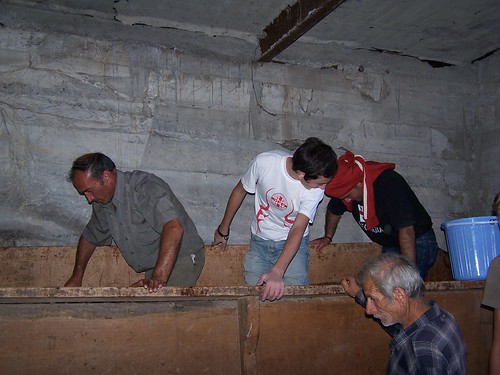
Next, we drove a short distance to Gela’s house where the rest of the winemaking would take place. Gela’s marani, or wine cellar, is attached to his house and directly across from his pig-sty. The main features of a marani are the kvevri and the crushing trough (I know neither the Georgian name nor the correct English viticulture term for it). Kvevri are large clay pots buried up to their openings in the ground. It’s in these kvevri that the wine is fermented. Gela’s marani holds kvevri ranging in size from a mere few hundred liters up to 1600 liters—the largest about six feet deep and the opening large enough for a slender man to slip inside. The trough is a marvel. Measuring 15 feet long by 3 feet wide by 3 feet high, it was carved from one oak tree more than 3 generations ago. It took 18 strong men to move the trough into the marani.
Now was the fun part. In all, we had more than 90 bags of grapes, each weighing approximately 40 kg. We carried 8 or 9 bags at a time from the truck and dumped them into the trough, and… Yep, we crushed them with our bare feet. For the first crushing, a wild herb was added to the bottom of the trough. The herb is supposed to give white wine many of the healthy properties of red wine. 4 or 5 people stood in the trough at a time. When the fresh plump grapes are first dumped, everyone simply treads on the grapes. The experience is almost like being on a stair-stepper at the gem: you pull your feet out of the grape muck (it isn’t very pretty) and up onto the mound of uncrushed grapes and you sink back into the muck. The work is much more fun than it sounds, especially with a glass of wine in hand. After grape mound has been beaten into a juicy pulp, the work is divided into two groups: those who are at the end of the trough and those towards the center. Those at the end continuing squishing the grapes, trying to squeeze as much juice out of the grapes as possible; those in the middle have the job of preventing the pulp from sliding away from the squisher so that only the juice flows down and out the spigot (basically, keeping the spigot from getting clogged). The juice flows down a wooden chute directly into the kvevri When 95% of the juice has been squeezed out, the remaining pulp is scooped into buckets and dumped into the kvevri. Everything from the grape—juice, skins, seeds, and stems—ultimately ends up in the same place. After the first fermentation (about a week), the pulp will have settled to the bottom and the new wine is ladled out into new kvevri where it will undergo further fermentation. The pulp is not thrown out; instead, it is distilled to make chacha, a very strong brandy.
If you couldn’t guess, wine plays a central role in Georgian culture. For those who’ve read about my earlier adventures will know that it’s nigh impossible to have a Georgian meal without draining a pitcher of wine. As you might expect from a culture in which drinking is a part of daily life, people drink responsibly; drunkenness is frowned upon. At more formal dinners, known as supras, which can last several hours and even days (I haven’t yet had the pleasure (?) of attending one of these marathon events), drinking is coordinated by the tamada, or toastmaster. It is the tamada’s job to make sure that everyone is a bit buzzed but no more by limiting alcohol intake to the toasts he carefully spaces out. Usually, the less hangover-inducing white wine is imbibed at supras instead of red wine (“black wine” in Georgian).
Back to the vineyard. This is the time of year for the harvesting (vintage; “rtveli” in Georgian) of grapes and subsequent wine making, and Fr. Theodore invited me along with some other mostly American guests to take part in this ancient tradition. We left Tbilisi a little past 8 am. I rode in a hired Marshrutka along with two young Georgian artists, part of the Perdue family, and Anne Brown and her son Kevin. The rest of our convoy was made up of two Toyota Land Cruisers: one driven by Fr. Theodore, carrying Giorgi, the rest of the Perdue family, Giorgi’s cousin Kaki, and two professional photographers from Russia; the other by John Hanson, carrying his newlywed Georgian wife, Salome, and his brother, Eric. John works for USAID. Mike Perdue has a background in dairy farming in Iowa, but wanting to do something different, is hoping to start a livestock business in Georgia. Anne Brown and her husband John are from Nashville and have been in Tbilisi since January. John is a retired judge who is volunteering his time to help the struggling judicial system in Georgia.
Before arriving at the vineyard, we stopped at a roadside restaurant to have a hearty brunch of mtsvadi (shish-kebab), bread, cucumber and tomato salad, cheese, and buffalo yogurt. Stuffed, we continued along the highway, watching herds of sheep, goats, and stray donkeys out the windows. Fr. Theodore’s one hectare vineyard is but one among a sea of vineyards in the valley. The vineyard has been in Fr. T’s possession for almost 6 years, but each year his vines have born fewer and fewer grapes. This year, his vine master, Gela, tried something different, pruning the vines such that that more shade would be available for the grapes on the north-facing side—more grapes, fewer raisins. And indeed it worked. Luckily for us grape-pickers, only half of the one hectare had vines bearing grapes; the other half contained immature vines planted last year. Nonetheless, the vines in the half-hectare (~1.25 acres) produced over three tons of rkatsiteli (a white grape) grapes.
We were quickly put to work, separated into teams of three, each armed with a sharp knife. We sweated under the heat and occasionally cut ourselves with our knives. The juice from the sweet grapes quenched our thirst and staunched the flow of blood from any cuts. In all, there were approximately 15 of us working half of the vineyard; the other half worked by a half-dozen local women. Many hands make light work and within a couple of hours we had completed the harvesting of the grapes, packed them into plastic bags, and loaded them onto an ancient truck.
Next, we drove a short distance to Gela’s house where the rest of the winemaking would take place. Gela’s marani, or wine cellar, is attached to his house and directly across from his pig-sty. The main features of a marani are the kvevri and the crushing trough (I know neither the Georgian name nor the correct English viticulture term for it). Kvevri are large clay pots buried up to their openings in the ground. It’s in these kvevri that the wine is fermented. Gela’s marani holds kvevri ranging in size from a mere few hundred liters up to 1600 liters—the largest about six feet deep and the opening large enough for a slender man to slip inside. The trough is a marvel. Measuring 15 feet long by 3 feet wide by 3 feet high, it was carved from one oak tree more than 3 generations ago. It took 18 strong men to move the trough into the marani.
Now was the fun part. In all, we had more than 90 bags of grapes, each weighing approximately 40 kg. We carried 8 or 9 bags at a time from the truck and dumped them into the trough, and… Yep, we crushed them with our bare feet. For the first crushing, a wild herb was added to the bottom of the trough. The herb is supposed to give white wine many of the healthy properties of red wine. 4 or 5 people stood in the trough at a time. When the fresh plump grapes are first dumped, everyone simply treads on the grapes. The experience is almost like being on a stair-stepper at the gem: you pull your feet out of the grape muck (it isn’t very pretty) and up onto the mound of uncrushed grapes and you sink back into the muck. The work is much more fun than it sounds, especially with a glass of wine in hand. After grape mound has been beaten into a juicy pulp, the work is divided into two groups: those who are at the end of the trough and those towards the center. Those at the end continuing squishing the grapes, trying to squeeze as much juice out of the grapes as possible; those in the middle have the job of preventing the pulp from sliding away from the squisher so that only the juice flows down and out the spigot (basically, keeping the spigot from getting clogged). The juice flows down a wooden chute directly into the kvevri When 95% of the juice has been squeezed out, the remaining pulp is scooped into buckets and dumped into the kvevri. Everything from the grape—juice, skins, seeds, and stems—ultimately ends up in the same place. After the first fermentation (about a week), the pulp will have settled to the bottom and the new wine is ladled out into new kvevri where it will undergo further fermentation. The pulp is not thrown out; instead, it is distilled to make chacha, a very strong brandy.
Our wonderful experience in Kakheti ended with a cookout under the stars (and at least one shooting star) at Fr. Theodore’s cottage. We ate mtsvadi, cooked by Giorgi over grape vines, cheese, and bread. And of course, we drank wine.
As always, visit my flickr site for photos (flickr.com/photos/rugbyxm)
Friday, October 5, 2007
Back in Tbilisi
I’m writing this post in
I should say that this idea was originally not mine. One of my Georgian teachers, Nana, told me during one of my lessons that it would be a shame if I stopped my lessons after only 5 weeks as I was making much progress. And indeed, I too thought it would be a shame to lose what I had worked so hard to gain. With my increasing knowledge of Georgian, I began to speak with Georgians (albeit my conversations were simple) in Georgian. This seemingly simple act enabled me to see
Nana suggested that I come back in September and study at the medical university and continue taking lessons. And that’s pretty much what I’ve done. I returned to the states on the 28th of August as I originally planned to spend 3 ½ weeks with my family in
Before I could go back to
After one last all too familiar lunch at Pierce (my cafeteria), I said one last good-bye and headed off to O’Hare. Those familiar with my first hectic journey to
I arrived in
The next day held a bit more excitement. I was scheduled to meet my candidate host family later that day, but before I even headed out the door, Fr. Theodore received a phone call warning us that there was going to be a large-scale demonstration organized by a newly formed opposition party on the steps of Parliament. Just two days earlier, Irakli Okruashvili, ex-Defense Minister and former ally of President Mikhail Saakashvili, made a dramatic return to politics, introducing his opposition party “Ertiani Sakartvelostvis” (“For a United Georgia”) on broadcast television and at the same time accusing current President Saakashvili of corruption and even having a hand in the accidental death of the former Prime Minister (the official report is that he died of carbon monoxide poisoning). During the evening of the 27th, masked men arrested Okruashvili in his home and he was charged with multiple corruption charges, sparking the call to demonstrate the next day. There probably is some truth to Okruashvili’s accusations, but Okruashvili is also probably no more innocent—such is the state of politics in this post-Soviet Republic. Fortunately, the demonstration, while attracting thousands, was peaceful, but the demonstration marked the first real opposition to Saakashvili and the political situation here is certainly less stable as a result.
Nana, my Georgian teacher, helped me find my host family. Duna and Temo are a married couple in their 50s. Their two-bedroom apartment in the district of Saburtalo was once also the home of their now grown son, Lekso, married and currently working for the Georgian Embassy in
Next post: Vintage and winemaking in Kakheti.
Post to come!
I had a post typed up on my laptop and saved to my flash drive, but the internet cafe I'm in doesn't have available USB ports!! I promise I'll have one if not two posts up sometime tomorrow. In the meantime, check out some recent photos on my flickr site (flickr.com/photos/rugbxym)
Ryan
Ryan
Tuesday, September 4, 2007
Javakheti Part 2: The summer camp at Mir a Shkhani

The small village (about 50 families) of Mir a Shkhani is an anomaly within Javakheti. First of all, the people there are ethnically Georgian, unusual in the mostly Armenian province. Second of all, they are all Muslim. The village most likely converted during one of the invasions coming from nearby Turkey (only a few kilometers away) several centuries ago.
The camp for college-aged youth (all from Tbilisi) was based in Mir a Shkhani’s two school buildings near the Mtkvari River (the river which eventually flows through Tbilisi). Organized by Metropolitan Nikoloz and funded by World Vision, a Christian organization, the camp was an island of Christianity in this Muslim village. But differences in religious belief never became an issue and the people of Mir a Shkhani welcomed us and showed us the hospitality one comes to expect from Georgians.
Now, this wasn’t your typical summer camp. There was work, hard work. And lots of it. The main objective of the camp was to restore an ancient church carved into the mountainside. It was only discovered 5 years ago—not surprising, as all that is visible from the outside is a small rectangular hole big enough for someone to crawl into—and little is known about its history. It is believed (how, I don’t know) that the church was dedicated to St. John the Baptist and it is for this reason that it is called Tavkvetila—literally, “head severed,” referring to how St. John the Baptist met his end.
There are two rectangular-cut holes that lead into the church. The first, at the base, leads to a vertical shaft 12 feet in height. A ladder provides the only means of gaining entrance to the church. Presumably, the entrance was designed this way in an effort to keep animals out of the church (it worked but not entirely—there was an active swallow’s nest in the church). The second hole is about 30 feet directly above the first. It is the only window into the church and provides all the light. The church is quite large, measuring about 20 ft x 40 ft x 20 ft high, a size that is even more impressive when one considers that it was carved entirely out of rock.
While certainly large enough to hold 40 or 50 worshippers, Tavkvetila is not large enough to contain the crowds that come on September 11th (the feast day of St. John the Baptist on the Julian calendar). In the past, the overflow was forced to stand outside on the uneven terrain (it is a mountainside). But now no longer. The camp participants built two large terraces out of stone on which people can stand outside the church. The larger of the two terraces measures 100 ft long and stands 7+ ft at the highest point. And they did a good job—their progress was regularly evaluated by architects from Tbilisi who praised the students’ excellent work.
Derek and I joined the camp in its second half (in all, 4 weeks). We were rather unceremoniously dropped off by Fr. Theodore who said something about picking us up the next week. Derek and I would be staying in the men’s building (there being 2 parts to the school) in one of the tiny classrooms. The room was tiny, the floors wooden and dusty, and the window had a pane missing. We would be roughing it.
That first afternoon was a bit awkward. Here we were, two Americans who didn’t know much Georgian, arriving halfway through a camp. We exchanged greetings with the 20-odd students at the camp but for the most part, we didn’t speak much with them, instead clinging to Nes and Nino, the two English-speakers. But soon enough, their curiosity of Americans together with their Georgian hospitality and my desire to practice my Georgian broke the ice and very quickly I made many good friends.
As dusk approached that first day, we were visited by 3 monks from Vardzia monastery (the cave monastery). They came bearing gifts of watermelon and fresh honey from their own bee hives. They soon joined a game of volleyball that was underway in the school yard (the volleyball net was a gift from World Vision, and it quickly became a favorite evening pastime, not just for us, but for the entire village). It was quite surreal to watch monks in their cassocks playing volleyball…
Here’s the schedule of a typical day at the camp:
6:00 am: Wake up, brush teeth from spring, drink tea, fill jugs with water from spring under the bridge. Watch the cattle being driven by the villagers into the mountains. The men taking on the large cattle and water buffalo; the women and children driving the calves
7:00-7:30: Depart for worksite 2 km away (Tavkvetila) carrying water jugs, stopping to pick apricots. Ford Mtkvari River and climb up mountainside to reach worksite
7:30-11:30: Perform backbreaking work while we’re still protected by the shade of the mountain. Listen to morning prayers being read by volunteer.
11:30-12:00: Eat delicious lunch prepared by the girls (some of the girls worked at the site, too) back at camp and carried to us by one of the guys who slept in.
12:00-2:00: Return to work; now in the sun
2:00-2:30: Head back to camp; ford river, this time not making an effort to avoid falling in (by now it’s very hot), if haven’t fallen in, pushed in by one of the guys
2:30-6:00: Relax, nap, chat with others, swim in the Mtkvari River
6:00-6:30: Have supper (usually bread, cheese, tomato and cucumber salad, potatoes, pasta, honey)
6:30-8:30 (dusk): play volleyball or soccer with locals
8:30-10:00: talk on the porch, practice Georgian
10:00-10:30: evening prayers
11:00-6:00: sleep, unless interrupted by prank
As we had arrived towards the end of the camp, most of the hard labor had already been completed. The terraces had already been built; all that was left for us to do, was to backfill the larger terrace and excavate two cells below the church (most likely used for storage). The work was still hard, often involving breaking up large rocks; by the end, my hands were quite blistered.
Derek, unfortunately, became quite ill with food poisoning (not at all surprising given that we weren’t living in the most sanitary of conditions; everyone got sick at some point and I would have my turn soon) during our second day at the camp and was subsequently whisked away to the more comfortable monastery in Baraleti to regain strength where he stayed for almost 5 days. Without Derek, I lost the only person I had been speaking in English to regularly. Sure, Nino, Nes, and a few other students could speak English, but they knew that I wanted to learn Georgian so they made a point of speaking to me in Georgian, and they only spoke to me in English when I had no clue as to what they had said. I was totally immersed in Georgian—and I loved it. The English-speakers took it upon themselves to teach me the more difficult aspects of Georgian while the others, mainly the guys, taught me phrases and short poems. The guys especially had a lot of fun with me: they would teach me a phrase that they swore was innocuous and have me repeat it to the girls, which I would naively do. Based on the girls’ reactions, I would find out that the phrase wasn’t so innocuous…
More still to come.
As we had arrived towards the end of the camp, most of the hard labor had already been completed. The terraces had already been built; all that was left for us to do, was to backfill the larger terrace and excavate two cells below the church (most likely used for storage). The work was still hard, often involving breaking up large rocks; by the end, my hands were quite blistered.
Derek, unfortunately, became quite ill with food poisoning (not at all surprising given that we weren’t living in the most sanitary of conditions; everyone got sick at some point and I would have my turn soon) during our second day at the camp and was subsequently whisked away to the more comfortable monastery in Baraleti to regain strength where he stayed for almost 5 days. Without Derek, I lost the only person I had been speaking in English to regularly. Sure, Nino, Nes, and a few other students could speak English, but they knew that I wanted to learn Georgian so they made a point of speaking to me in Georgian, and they only spoke to me in English when I had no clue as to what they had said. I was totally immersed in Georgian—and I loved it. The English-speakers took it upon themselves to teach me the more difficult aspects of Georgian while the others, mainly the guys, taught me phrases and short poems. The guys especially had a lot of fun with me: they would teach me a phrase that they swore was innocuous and have me repeat it to the girls, which I would naively do. Based on the girls’ reactions, I would find out that the phrase wasn’t so innocuous…
More still to come.

Subscribe to:
Posts (Atom)

